AI Coding Tools Replacing Junior Engineers
AI is replacing specific junior tasks, not junior engineers themselves.

Junior engineering hiring is shrinking. Engineering as a whole is not. Since 2019, engineering headcount at large tech firms has fallen by much less than overall tech headcount, and engineers still made up a majority of all new hires at those firms in 2025. The contraction is happening at one level of the ladder, not across it.
Job postings show the split clearly. New-grad postings have dropped sharply from their 2022 peak. In the same companies, during the same stretch, senior and staff-level postings have stayed flat or kept growing. Two opposite trends, running at the same time, inside the same org charts.
Payroll data backs this up at the national level. Stanford researchers looked at ADP payroll records and found that employment for workers aged 22 to 25 in AI-exposed occupations sits well below trend. Employment for workers 35 and older in those same occupations held stable or grew over the same period. Age, not job category, is the dividing line. Something is pulling the bottom rung of the ladder away while leaving the rest of the ladder standing, and the rest of this piece is about what that something actually is.
The Task Layer AI Tools Eliminated
AI coding tools are not replacing engineers as a category. They are eating a specific set of tasks, and that set happens to be the exact bundle of work that used to justify a company hiring a junior engineer in the first place: turning a well-written ticket into working code, writing tests that follow an existing pattern, and fixing bugs with a narrow, known scope.
Those three tasks have something in common. Each one is well-specified, repeats a pattern the system has seen before, and stays inside clear boundaries. That combination, well-specified, repetitive, bounded, is precisely the condition under which an AI coding assistant now performs at the level of a junior developer, or above it.
Two years ago, AI tools mostly worked like a faster autocomplete, but that has changed. By 2026, agentic tools complete entire workflows on their own: they read a ticket, write the code, write the tests, open the pull request, and respond to comments left in code review, without a person steering each step. That shift, from autocomplete to agent, is what turned "AI makes juniors faster" into "AI does the junior's job."
Coursera's 2026 analysis names this directly: agentic tools now act closer to entry-level software engineers than to assistants. That's exactly why the things a junior used to learn on the job (foundational computer science, system design, the habit of thinking critically about a problem before coding it) matter more now, not less. The tool can write the function. It still needs someone who understands why the function should exist.
Cognition's Devin shows what this looks like in practice. On an industry benchmark that tests an AI system against real-world GitHub issues pulled from popular open-source projects, Devin resolves a measurable share of those issues on its own. Companies running Devin on routine feature work and bug fixes report needing fewer junior developers to handle that same load. The tool is good at a specific kind of work, and that kind of work used to be a job title.
What companies are actually doing in response, and what the two divergent bets reveal
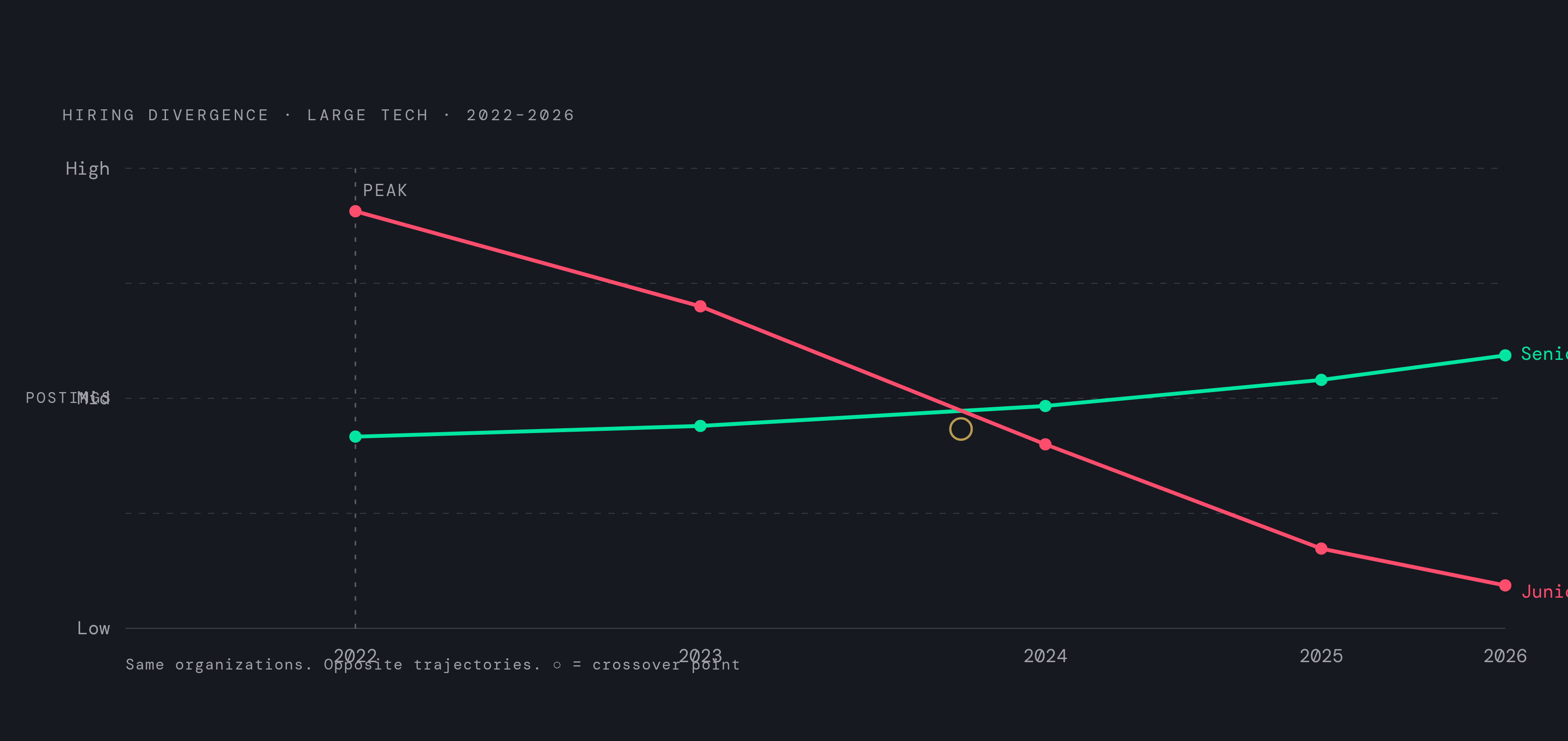
Companies have not settled on one playbook. They are placing two different bets, and the gap between them exposes a real tension between saving money now and keeping a pipeline of future senior engineers later.
Salesforce is the clearest public example of the cost-efficiency bet. CEO Marc Benioff said the company hired no new engineers in fiscal year 2026, crediting AI agents with absorbing that work, and Salesforce cut its support headcount by nearly half over the same stretch. That is a company deciding, in public, that AI agents can substitute for junior hiring at scale.
The arithmetic behind a decision like that is simple to state. An AI tool seat costs a small fraction of a junior engineer's fully loaded annual pay. Measured one year at a time, cutting junior hiring and buying more AI tool licenses looks like straightforward savings on a spreadsheet.
That arithmetic leaves something out. Growing a new graduate into a senior engineer takes years, not quarters. A company that stops hiring at the junior level for several years in a row is mechanically building a senior engineer shortage for itself a few years out, because there's no other door through which senior engineers arrive, even as it saves money today.
Gartner reported that a notable share of chief human resources officers said at least one business leader inside their own organization had already stopped hiring for entry-level roles specifically because of AI automation. Only a minority of those same organizations said AI had delivered significant or transformational value. Plenty of companies are cutting junior hiring on a belief about AI's payoff that most of them haven't actually confirmed.
IBM represents the other bet: restructuring the junior role. What that restructuring looks like, in practice, is the subject of the next two sections, but the short version is that IBM treated junior engineers as a role to redesign.
Where the Counter-Evidence Is Strongest
The strongest pushback against this argument does not knock it down. It sharpens it, by showing that AI is one real factor in junior hiring's decline, not the only one.
The Stanford research team that produced the ADP payroll findings said so directly in a subsequent update. Once they controlled for firm-level and time-level effects, the employment decline for young workers "becomes significant only in 2024." The earlier declines, they wrote, are "likely (at least partly) due to some combination of other factors, not just AI." The same researchers stated that they "do not believe that AI is always and everywhere the sole determinant of employment.
Other forces were already pushing junior hiring down before agentic AI became common. A post-pandemic hiring correction, interest rate increases that made growth-stage tech spending more expensive, and changes to how developer salaries were treated for tax purposes all shaped headcount decisions between 2022 and 2024. AI is a real part of the story. It is not the whole story.
A separate finding on GitHub Copilot complicates the picture further, and in an interesting direction: productivity gains from AI coding tools were largest among less experienced developers. That means AI tends to close the gap between a junior and a senior. A company cutting junior headcount on the theory that AI replaces junior output may be reading the data backward: the tool's biggest lift goes to the person with the least experience, not the most.
Yale's Budget Lab adds a final wrinkle. Looking across the economy as a whole, Yale found no statistically significant relationship between how exposed an occupation is to AI and how its employment actually changed. That disagreement with the Stanford findings reflects real uncertainty in the underlying data, not a conclusive answer in either direction.
Put together, this evidence points toward restructuring junior roles. The IBM-style approach holds up better than the Salesforce-style approach, because the companies cutting junior roles outright are often acting on a signal that is messier and less settled than they're treating it as, while quietly giving up the pipeline that produces their senior engineers five years from now.
Which Tasks Remain
A clear set of tasks keeps resisting automation, and they share a structural trait: each one calls for judgment in a situation that has no clean answer, or depends on information no codebase contains, or carries a level of accountability a tool cannot hold.
Architectural decisions sit at the top of that list. Choosing between microservices and a monolith, weighing cloud cost against security requirements, deciding which technical debt to pay down now versus later: these calls depend on team dynamics, institutional history, and business priorities that live nowhere in a repository. An AI tool can read the code. It cannot sit in the meeting where the company decided to prioritize a security audit over a feature launch.
Turning ambiguous requirements into a real decision is another one. An AI system can take a well-specified ticket and turn it into working code without trouble. It has no way to decide which of two conflicting readings of an underspecified ticket is the right one, or what to do when a business request runs into a regulatory constraint the ticket never mentioned. Someone still has to make that call and own it.
Validating AI output at scale has become its own discipline. Senior developers are spending noticeably more time on code review now than before AI tools became standard, because reviewing a large volume of machine-generated code every day is a different cognitive task than reviewing a smaller volume of human-written code. Reading code for correctness at that pace, and catching the subtle mistakes AI tools tend to make, is a skill in its own right, not a side effect of the job.
On-site, environment-specific debugging stays stubbornly human too. In the Coffeebot IoT project, AI tools built the dashboards and the data pipelines without trouble. The AI could not resolve sensor drift and network instability that appeared once the hardware was running inside an actual café. Those problems became visible only to someone physically present in that environment, working with the hardware as it behaved in the real world.
What the entry-level bar now requires, in concrete terms
The entry-level job posting has already rewritten itself, and the distance between the old version and the new one is the clearest evidence of what companies now expect from a junior hire.
Two years ago, a typical junior posting asked for proficiency in a framework, familiarity with Git, and a year or two of experience. Where junior postings still exist today, they ask for something different: experience with AI-assisted development workflows, the ability to review and validate AI-generated code, some familiarity with prompt engineering for code generation, and hands-on experience with at least two AI coding tools.
IBM's restructured intake process points at what a productive junior engineer now spends time doing. Less time turning a spec into boilerplate code. More time on task decomposition, breaking a vague requirement down into precise, modular pieces an AI agent can actually execute, more time validating what the agent produces, and more time translating what a stakeholder actually wants into something an engineering team can build.
Coursera's 2026 analysis names three skill clusters that hold up against this kind of automation: task decomposition, system architecture and design, and production hardening, the work of taking a prototype and making it ready for real use by auditing the machine-generated code underneath it for security holes and checking how it holds up under load. These three recur constantly across companies restructuring junior roles, because they sit exactly on the part of the work an AI agent still cannot do on its own.
Job postings that list AI-related skills already pay noticeably more than postings that don't, and the gap is a market signal that fluency with these tools has become a distinct, priced skill.
The founding engineer role, now common at AI-native startups, shows where this bar tops out. It asks for a generalist with broad ownership, equity pay, a real say in architecture and hiring decisions, and the ability to build evaluation frameworks for AI systems, not just stitch together a wrapper around someone else's model. Founders filling these roles say the most common mistake is hiring someone who can wrap an API call but cannot build the evaluation harness that tells you whether the system is actually working, which marks the ceiling of this bar. The floor, task decomposition, AI fluency, and the discipline to validate what a machine produces, is what every junior engineer entering the field in 2026 needs to clear.
How to read which engineering roles are actually growing, and what they signal about where to specialize
The split in engineering hiring runs through role type as much as it runs through seniority, and knowing the difference between adjacent AI-era roles tells an engineer where effort spent now pays off later.
AI and ML engineer postings have grown sharply over the same period junior postings fell. Senior developer roles asking for six or more years of experience have kept growing too, while mid-level postings have contracted by a modest amount. The ladder is reshaping around which roles sit where, not just getting shorter at the bottom.
Junior engineers often lump three AI-adjacent roles together, and they are not the same job. An AI engineer builds a capability a customer actually touches, drawing on software engineering fundamentals, model APIs, retrieval systems, agents, and evaluation work. It's the role most startups at the Series A or B stage actually need to fill. An ML engineer owns a production machine learning system that already exists, and the job is keeping it reliable and performing well over time. A research scientist produces new knowledge or new model capability, a role that mostly matters at foundation model companies, where research output is the product itself.
The way technical interviews are run reflects this split already. Interviewers increasingly ask less about how fast someone can write code and more about how well someone reasons through a problem, including questions about how language models behave and where they tend to fail.
The founding engineer path has gone global. AI-native startups in Europe, India, and other major tech hubs are hiring remotely with the same structure: equity-heavy compensation, high ownership, built around the need for one or two exceptional generalists. For a junior engineer deciding where to put their energy, the skills named in the previous section, task decomposition, fluency across multiple AI coding tools, the ability to validate what those tools produce, function as the on-ramp to every one of these paths. Which specific role fits best depends on temperament and interest. The skills that get someone through the door are the same ones, no matter which door it is.