Tech Layoffs and Hiring Freezes Weekly Tracker
Tech companies are cutting legacy roles while hiring for AI-native work.

The 2026 layoff wave is still picking up speed. As of October 8, 2026, trackers have logged 519 layoff events this year, touching hundreds of thousands of workers, and the daily pace this year is running faster than all of 2025 combined. That's the baseline for everything else in this tracker: the cuts aren't slowing down, and the industries absorbing the most damage are the ones closest to software itself.
This week's clearest named event comes from Workday, which cut a small share of its workforce, concentrated in Product and Technology teams. Workday isn't an outlier in terms of which teams are getting hit. Across the year, Software & Tech leads every other industry in total workers affected, with IT Services and IT Consulting close behind, and Finance & Fintech close behind that. Telecommunications rounds out the top four. The pattern holds week over week: the roles closest to writing and shipping code are taking the deepest and most frequent cuts, not the roles furthest from it.
AI as the named cause in nearly half of 2026 cuts
AI is now the single most common reason companies give when they cut jobs in 2026, ahead of restructuring, cost-cutting, and weak market conditions. Companies are putting what's happening behind closed doors in writing. Oracle's own FY2026 annual filing states plainly that "the adoption and deployment of AI technologies across our operations have resulted, and may continue to result, in reductions to our workforce." It's a company telling investors, in a legal filing, that this is now a standing policy.
The roles most exposed track exactly where AI tools have gotten good fast: customer support, content moderation, data entry, QA testing, and a good chunk of traditional software engineering. These are jobs built around tasks that current AI systems can now do a meaningful share of. That's precisely why they're the first cut when a company decides to restructure around the technology.
Visa cut a significant share of its workforce this year, mostly in technology and product, despite posting strong profit and running a $30 billion buyback. Visa's CEO said AI is helping "shape the way work gets done" at the company and tied that directly to the cuts, while also acknowledging AI wasn't the only factor. Analysts have flagged this kind of "AI washing": companies leaning on AI as the public explanation for cuts that may have just as much to do with overhiring during the last boom, softening revenue, or pressure from investors to show leaner headcount. That caveat doesn't weaken the broader signal. It sharpens it. Even accounting for cases where AI is doing some rhetorical lifting, the direction is consistent: companies that are adopting AI tooling are rebuilding their org charts around it, and the Oracle filing shows that's a policy decision, not a one-off.
The "cut legacy, hire AI-native" substitution pattern emerging in the data
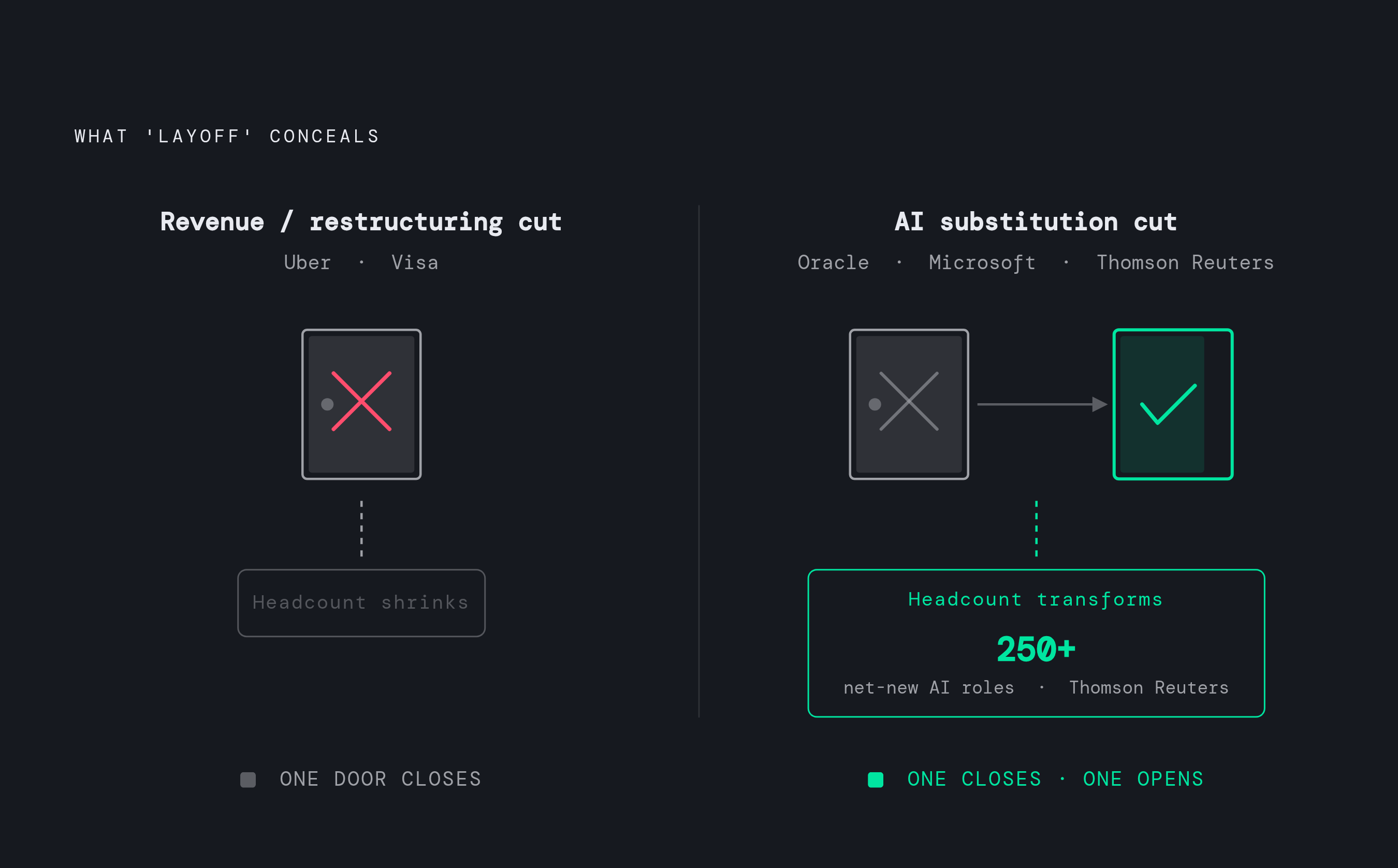
The most useful thing in this week's data is what companies are announcing right alongside the cuts. A growing number of employers are cutting legacy roles and opening AI-native ones in the same breath, sometimes in the very same press release. That's a different kind of signal than a plain layoff, and it changes how an engineer should read the announcement.
Thomson Reuters is the clearest example on record. The company confirmed engineering layoffs this year, but at the same time it announced more than 250 net-new engineering roles aimed squarely at senior and AI-native capability. That's not a company shrinking. Oracle's filing language fits the same logic: cuts tied to AI adoption are framed as something that "may continue," meaning this is policy.
The substitution pattern explains something that's been quietly devastating for new graduates: the collapse of entry-level hiring. AI now handles a lot of the routine, repetitive work that junior roles used to exist to absorb, so if a tool can do that output instead, the business case for hiring and training someone from scratch gets weaker every quarter. Economic uncertainty adds to the reluctance. Why invest months in training a new hire when the tasks they'd be doing are the ones AI already handles reasonably well?
This distinction matters when reading any individual layoff announcement. A company cutting headcount while publicly building toward "AI-driven customer outcomes," the language HubSpot has used, is making a different move than a company cutting because revenue fell short. One of those companies is closing a door. The other is closing one door and opening another, often in the same statement. Learning to tell those two apart is the single most useful skill this tracker can hand an engineer deciding where to apply next.
Where genuine hiring demand still exists inside the freeze
Broad tech hiring has contracted this year, but one cluster of roles is still growing, and it's growing for structural reasons that have little to do with the forces cutting everyone else. The clearest counter-signal is AI and machine learning hiring itself. The share of new hires going into AI/ML roles grew sharply in 2025, and the number of distinct AI/ML job titles companies are actively hiring for expanded by a wide margin over the same stretch. This reflects real, additional demand for a kind of work that didn't exist at this scale a few years ago, not companies relabeling old jobs with a new buzzword.
What used to be one general label, "AI engineer" or "ML engineer," has split into at least seven distinct jobs with concrete differences in scope and skill. An Applied AI Engineer spends their time on retrieval-augmented generation pipelines and agentic workflows. An MLOps or Platform Engineer handles inference infrastructure and GPU orchestration, the plumbing that keeps models running at scale. A Deep Learning Engineer works closer to the model itself, fine-tuning, running LoRA adaptation, coordinating training across multiple GPUs. The older labels "ML Engineer" and "AI Engineer" still get used interchangeably at a lot of companies, and what they actually mean depends on the day-to-day: traditional ML engineering still leans toward modeling work, while the AI engineering label increasingly points to building and managing agents.
Demand is also visible in places that rarely make an AI headline. Chips, power, cooling systems, drone and UAS platforms, and embedded systems are all seeing real and growing hiring, even though none of it gets the attention that a splashy foundation-model launch does. The same holds across a handful of adjacent sectors: AI-enabled productivity tools, healthtech, climate-focused companies, developer tools, automation, and infrastructure businesses are all still hiring in a market where plenty of other categories have gone quiet.
For anyone weighing a move into frontier AI labs specifically, the path matters as much as the title. Research scientists tend to earn somewhat more than ML engineers at the senior level, and most of that gap sits in equity rather than base pay, but some labs have moved to a single pay band across both tracks with no title-based distinction at all, a choice that shows how much weight that lab puts on foundation-model research specifically. Research scientist roles at most major labs effectively require a PhD. Anthropic is the notable exception: it doesn't formally require one, though it still expects a strong publication record, and that combination tends to mean narrower mobility if someone later wants to move to a different kind of company.
What the hiring freeze looks like from the inside
From a distance, the job market looks steadier than the layoff numbers suggest. Jobless claims aren't spiking, and no single headline crisis is pulling attention the way a market crash would. That calm is an illusion created by how the freeze actually works. Most of it is happening through inaction: no backfill when someone leaves, no replacement for an open seat, no announcement of any kind. A frozen seat doesn't appear in a layoff tracker, but it is just as closed to a job seeker as a role that a company eliminated.
That mechanism explains something that looks contradictory on the surface: weak hiring and long job searches can coexist with low jobless claims, because workers who already have a job are staying put rather than risking a jump into a thin market, and companies aren't backfilling the roles that would otherwise open up for someone new.
The slowdown isn't even across company stages. Early-stage companies have cut their hiring the most, with their hiring rate now running at only a little over half of what it was two years ago. Growth-stage companies pulled back too, though less sharply. Late-stage companies, by contrast, actually increased hiring slightly this year, a split that matters a lot depending on what kind of company a job seeker is targeting.
Startup founders, especially at AI-native companies, are responding by growing headcount slowly and making every hire count, and they use AI tools themselves to get more output from smaller teams. That approach is spreading beyond AI-native startups into the broader startup world. For candidates, the freeze creates a second problem layered on top of the first: a flood of job postings doesn't mean an easier search. AI has made it cheap for companies to post roles, and just as cheap for applicants to blast out applications and for companies to run automated screening on all of them. Volume stopped being the scarce resource. What's scarce now is a credible signal that can cut through that noise.
Reading these signals when deciding where to place your next bet
Everything in this week's data points to one decision rule: target companies that are actively running the substitution, cutting legacy headcount while building out AI-native roles, rather than companies that are simply sitting in a freeze. A freeze is a closed door with no second door behind it. A substitution is a company telling the market, in public, where it's investing next.
Telling the two apart is mostly a matter of reading the announcement closely. A company pairing layoffs with explicit AI investment, the way Oracle, Microsoft, and Thomson Reuters have all done this year, is making a public statement about where its future headcount is going. A company cutting for revenue reasons or general restructuring, without any AI-native hiring announced alongside it, the way Uber and Visa have this year, is making a different kind of move, and it deserves a different kind of attention from a job seeker.
The substitution pattern appears earliest at the startup stage, and the YC W26 batch's focus on vertical AI is a useful pointer. The strongest early-stage demand right now is in applied AI built for industries that haven't been touched yet. Engineers who can work on unglamorous, high-leverage problems in those industries are landing founding-team roles, not just junior seats.
The same logic appears at the other end of the market, inside frontier labs. Anthropic deliberately avoids drawing a sharp line between researchers and engineers: every technical employee carries the same title, Member of Technical Staff, and engineers routinely appear as authors, including first authors, on the company's research papers. That's a direct signal about what these organizations value most: someone who can move between research and engineering, not someone who has optimized narrowly for one track.
Hiring speed is also a signal worth acting on directly. The strongest engineers don't sit in open hiring processes for long. A company that can't move from first contact to an offer in under three weeks isn't built to compete for the best candidates in this market, and that's as useful a filter for where to apply as any data point in this tracker.
Put together, the strongest move for an engineer reading this week's numbers is specific: find the companies running the cut-and-rebuild pattern in a domain already well understood, reach them directly with concrete evidence of relevant work, and treat the speed of their process as a two-way signal, a test of them as much as of the candidate.