Open Source Repos That Went Viral This Week
Engineers are building the scaffolding for AI agents, not the agents themselves.

The repos that exploded on GitHub this week all point in the same direction: engineers are building the scaffolding that AI agents run on, not the agents themselves. Memory layers, workflow philosophies, skill files, harnesses, data-access tools. Nobody shipped a new model this week. Every breakout repo wraps around, tunes, or extends a model that already exists.
This matters because it marks a shift in what "AI development" even means in practice. You used to send one prompt to one model and get one response back, but now that pattern is giving way to coordinated systems of specialized agents working in sequence or parallel. The tooling that surged this week exists to serve that architecture. This week, AI Agent was the biggest category among the top repos, and AI Skills and AI Coding Assistant followed right after. Star counts for the week's breakouts ranged from a few thousand to a quarter million, and the pattern held at every point on that range: the infrastructure layer pulled the attention, not the models running underneath it.
The week's standout repos, taken one at a time
obra/superpowers is written in Shell, and it gives coding agents a full software-development methodology they can run on. It runs on composable skills and a set of initial instructions, and it drives subagent cycles where an agent can work for long stretches without drifting off the plan. The project leans hard on real red/green test-driven development, and it has an agent apply the YAGNI and DRY principles that have guided disciplined software teams for decades. It also comes with a companion eval lab, prime-radiant-inc/superpowers-evals, which runs actual coding-agent command-line tools through a QA agent and scores them on how well they stick to the workflow.
A methodology repo pulling this many stars says something specific: engineers don't just want a model to call. They want opinionated, end-to-end guidance on how to run an agent so it doesn't wander. The project's own framing calls out a familiar failure mode, the "lazy senior dev" problem, where an agent over-builds and solves a problem nobody asked it to solve. You should separate that from a different tool, caveman, which compresses what an agent says, not what it builds. The two solve different problems: one cuts unnecessary engineering effort, the other cuts unnecessary tokens. Some sources say that when you run both together, you get redundant overhead, not compounding savings. A harder problem causes both tools to fall short: agents forget everything between sessions. If an agent can't carry context from one sitting to the next, it can't run any workflow longer than a single session, so because superpowers makes every capability a swappable plugin, it lowers the barrier for the skill-file ecosystem covered next.
Panniantong/Agent-Reach, written in Python, gives agents direct web access: scraping and search across Twitter, Reddit, YouTube, GitHub, Bilibili, and XiaoHongShu, with no API fees. Some of those platforms need login credentials or cookies configured before they work. The repo has pulled in tens of thousands of stars total, and on a single day it added close to a thousand new stars by itself. Every agent builder eventually runs into the cost of live web data, which normally means paying per API call, and Agent-Reach removes that cost from the equation.
addyosmani/agent-skills is written in JavaScript, and it's a set of production-grade engineering skills for coding agents, published by a well-known former Google Chrome engineering leader who now works at Anthropic. It picked up hundreds of stars in a single day, and the spike traces back almost entirely to the author's reputation. When someone with that kind of track record publishes their working skill files in the open, you get instant credibility for anyone building a professional agent workflow. The repo also points to something broader: MCP-based agent composition is moving past pure software development and into creative and entertainment work. Rust shows up again this week as the default language of choice for ambitious open-source rewrites of tools that used to be proprietary, and that credibility signal runs through more than one of the week's non-agent breakouts.
The skill-file format as the week's quiet unifier
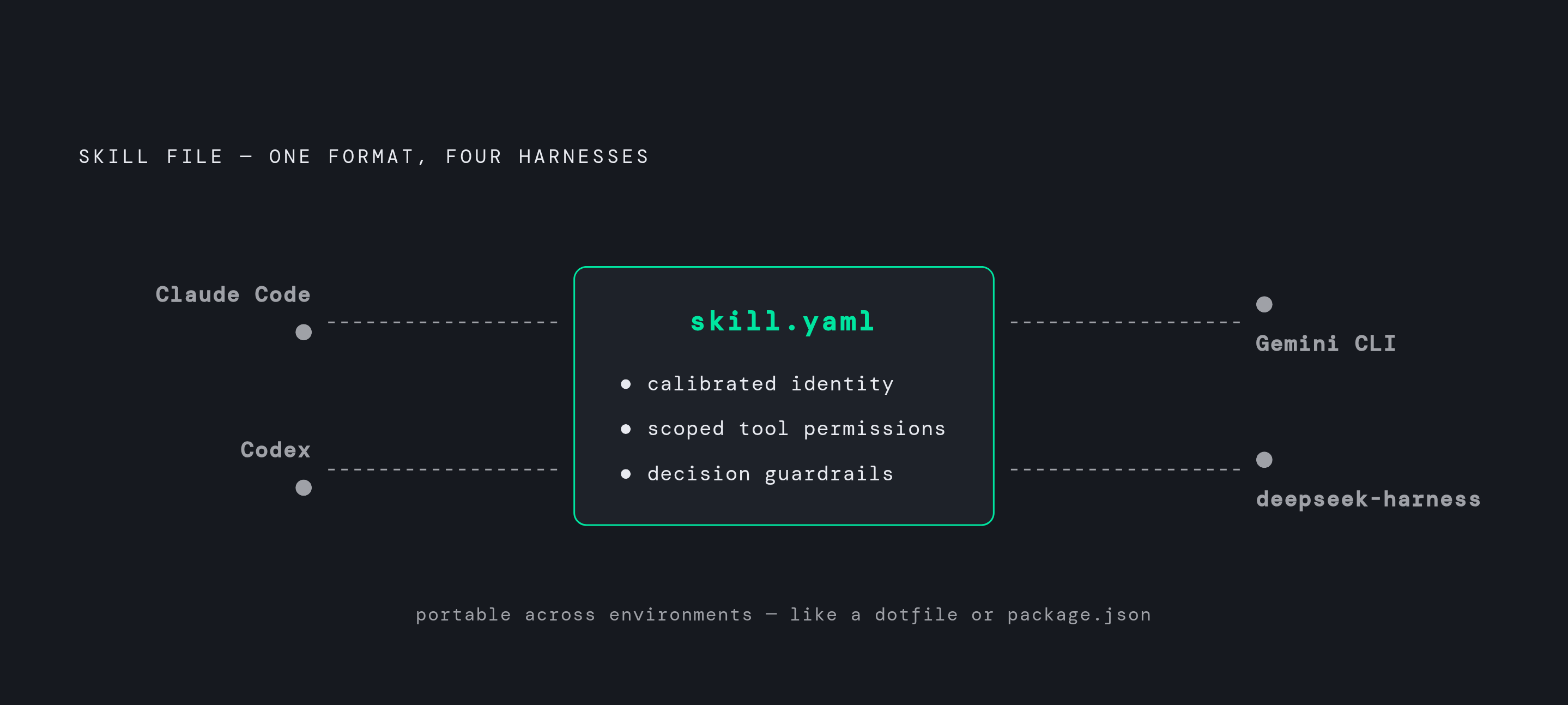
Most of this week's breakouts are skill files, or systems built natively around the skill-file format: a structured markdown document that gives an agent a calibrated identity, scoped permissions for which tools it can touch, and guardrails for the decisions it's allowed to make on its own. The format works the same way regardless of which harness runs it, whether that's Claude Code, Codex, Gemini CLI, or deepseek-harness.
The comparison to reach for here is the dotfile, or the package.json file that defines a JavaScript project. Those became the unit developers used to compose their working environment, shareable, versionable, portable across machines. The skill file is becoming that same unit for agent work: a single file format that travels across harnesses the way a dotfile travels across machines.
September's top 100 repo list had several pure skill-file projects sitting in the top ten on their own: tt-a1i/archify for architecture diagrams, mattpocock/skills ("Skills for Real Engineers, straight from my.agents directory"), another project tuned for accessibility-friendly agent output, cloudflare/security-audit-skill for multi-phase security audits, and cathrynlavery/diagram-design covering 42 diagram types. addyosmani/agent-skills fits the same mold this week: a working engineer publishing the skill files already running in production, not a packaged product launch.
calesthio/OpenMontage pushes the format the furthest of anything trending this week. It's an agentic video production system built from 12 production pipelines, and it combines more than 100 tools with over 700 agent skill and production-knowledge files. What started as a coding assistant becomes, through that stack of skill files, a full video production studio. If enough skill files accumulate around a single harness, you can scale it to entire creative pipelines.
The infrastructure layer is accumulating more stars than the model layer
The star counts are shifting toward infrastructure because the gap between frontier models has narrowed to the point where the model itself stopped being the differentiator. When the leading models converge on similar benchmark scores, and open-weight alternatives match them closely enough on reasoning tasks, the competition shifts to what surrounds the model. It moves to what the infrastructure around the model lets that model actually do.
The market is already pricing this. agents-radar's October 5 digest tracks repos that ship no models and no agents at all, pure infrastructure, and finds them accumulating hundreds of thousands of combined stars. affaan-m/ECC, which optimizes agent harness performance across skills, memory, security, and research-first development for every major coding agent, currently leads the LLM topic on GitHub. It's a harness optimizer. It doesn't ship a model of its own.
The clearest fault line sits at the retrieval layer: agents-radar notes that vectorless, reasoning-based approaches to retrieval-augmented generation are moving into the mainstream, and that directly challenges the long-standing assumption that vector embeddings are a required piece of any serious RAG system. That shift puts pressure on a meaningful slice of the skills that currently fill ML engineering résumés: Pinecone, Weaviate, Qdrant, and the vector-database ecosystem built around them. None of this means those tools disappear. The value chain is reorganizing: the layer once assumed to be the default architecture is now just one option among several, and it has to compete on its own merits against reasoning-based retrieval that skips embeddings.
Frame this as reorganization, not defeat, for any one layer. Models still matter, retrieval still matters, and none of the tools named above are losing anything for good. What's changing is where engineers need to put their attention if they want to build something that stands out. Attention is moving toward the harness, the memory system, and the skill file, which decides what a model is allowed to do and how well it remembers doing it.
Where engineers should specialize as the momentum shifts
The GitHub pattern this week doubles as a hiring signal. Fast-moving AI companies want to find the engineers who are building and shipping agent infrastructure right now.
The "Agent Engineer" role is still being defined on paper, but the repos trending this week define its real scope more precisely than any job posting currently does. Memory systems, skill files, harness optimizers, data-access tools: that's the job, laid out in public commits rather than in a list of bullet points on a careers page.
Publishing production-quality skill files has also become a public portfolio move with direct hiring weight. addyosmani's agent-skills repo spiked purely on the strength of its author's reputation, and that points to a broader shift: anyone evaluating an early engineering hire can now look at a candidate's actual agent methodology in the open, not just their commit history on unrelated projects.
Rust keeps appearing in engineers' choices this week as a way to signal ambition, and storytold/photocraft and lexmount/moli, a browser built for AI agents, both trended written in Rust. If you're picking a language for an ambitious side project, you now have real social proof that Rust reads as a serious, credible choice for that kind of rewrite.
The agentic coding tool market has split into two distinct groups, and each one hires in its own way. One group builds AI products. The other uses AI coding tools to move faster on products that are not AI. The repos trending this week serve the first group far more than the second.
The best openings at AI startups move fast, and often no job posting exists anywhere yet. The engineers most likely to land them are already working in this infrastructure layer: they ship skill files, contribute to harness repos, and build memory or retrieval primitives in public. They get found because of that work. Not because they sent in a résumé.
Sources
- 📈 AI Open Source Trends Weekly Digest 2026-10-05 · Issue #1622 · kakapez/agents-radar
- Latest 10 Trending Repositories - October 03, 2026 · Issue #569 · marc-ko/daily-trending-repo
- Latest 10 Trending Repositories - October 05, 2026 · Issue #571 · marc-ko/daily-trending-repo
- Latest 10 Trending Repositories - October 04, 2026 · Issue #570 · marc-ko/daily-trending-repo