The Technical Mandate Gap Between Series A and Series B AI Startups and What It Costs ML Engineers Who Pick the Wrong Stage
Series A and B want different ML engineers, and a mismatch costs skills.
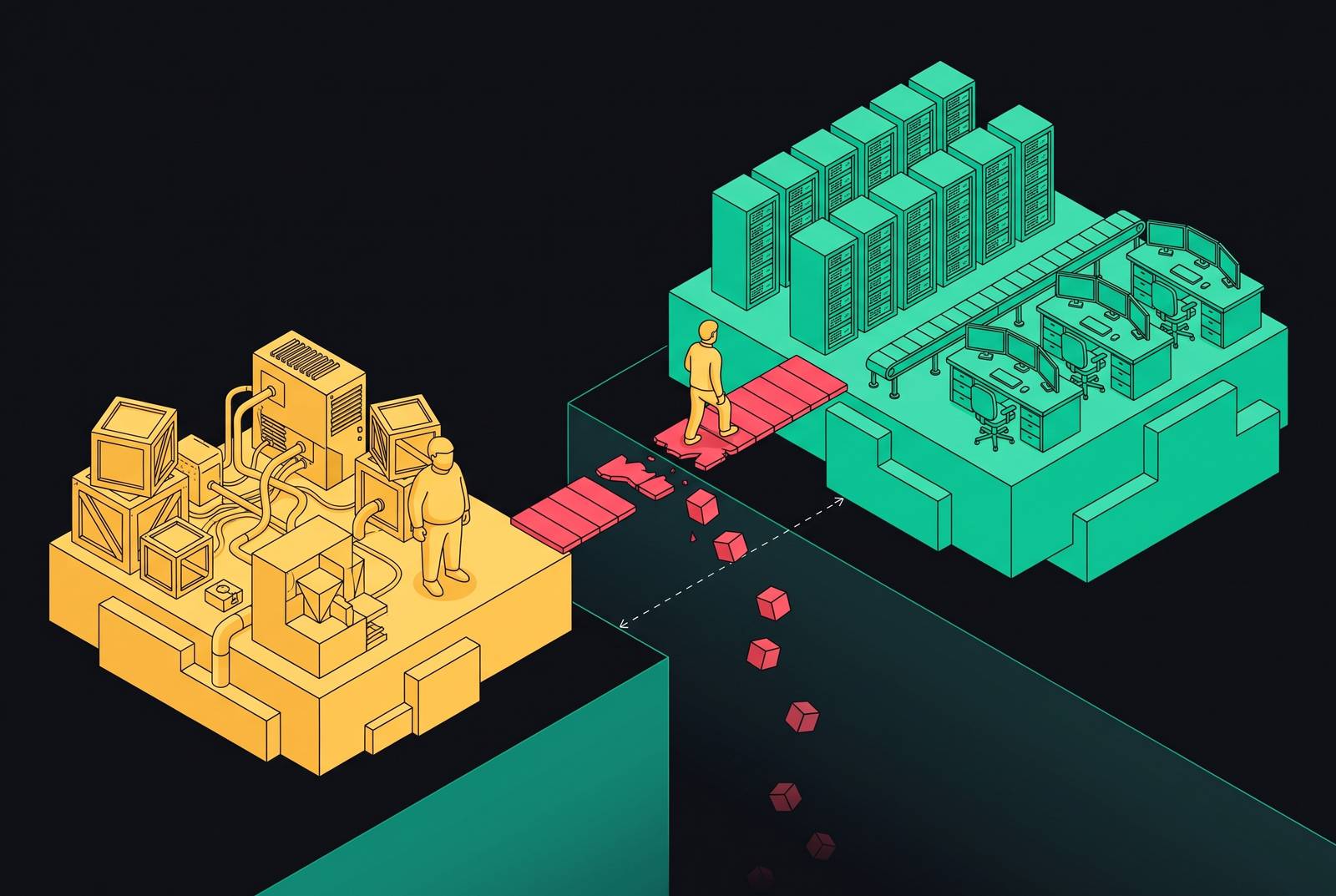
ML engineer career opportunities at Series A and Series B AI startups differ in what the engineer must deliver. Series A needs engineers to make the delivery loop repeatable, while Series B needs them to take production ownership at scale. Picking the wrong mandate can leave an engineer with wrong-shaped skills, stalled scope, and equity that does not match their actual leverage. The right choice depends on the engineering work the company needs.
Why Series A and Series B AI startups are structurally different engineering environments, not just different sizes
At Series A, shipping an AI feature is possible, but each release may still be bespoke and fragile. The constraint is repeatability. At Series B, the product exists, but sustaining it depends on inference margin and coordination overhead. More engineers alone will not resolve either problem.
The team’s shape reflects that difference. At Series A, product engineers with strong AI integration ability form the plurality, supported by applied ML and evaluation specialists, a smaller platform and data layer, and lean management and security support. At Series B, infrastructure can split into named teams for GPU cluster SRE, training platforms, and inference platforms. At that stage, the fleet can grow to as many as 1,024 GPUs, supported by five to fifteen infrastructure engineers and a dedicated GPU cluster SRE team.
These ownership arrangements differ along with the staffing levels. One needs engineers to make delivery repeatable across an unfinished system. The other needs engineers to own defined parts of a production system whose operating cost now shapes the business.
What the Series A mandate actually demands from an ML engineer day to day
At Series A, the ML engineer’s job is to shorten prototype-to-production time while owning the full delivery loop. That includes responsibility across evaluation, inference cost, and product handoff. The work stays close to the customer. Model performance has to become a feature that can be delivered repeatedly without another round of bespoke engineering.
The founding or early AI engineer therefore works directly with founders to set technical direction, decides how to build the architecture, and moves between research and engineering. Establishing working practices is part of the job while the product is still being built. The Forward Deployed Engineer, or FDE, archetype expresses the customer-facing side of this mandate. Ember AI, a seed-stage company, illustrates why that proximity can arrive before Series A. Its founding engineer role sits in a business with early revenue and major enterprise customers already onboard.
SPEQD makes the system-ownership requirement more concrete. Its Founding Harness Engineer is the first engineer on the team, designing sandboxed compute environments, verification loops, and deployment pipelines. The role requires over a decade of production software delivery experience. This early-stage role demands someone who can connect the pieces and take responsibility for delivery.
What the Series B mandate actually demands from an ML engineer day to day
At Series B, the ML engineer’s job shifts toward production ownership within defined service boundaries. The work includes latency budgets, inference cost attribution, and on-call responsibility. Ownership becomes narrower but more explicit. An engineer must know which part of the system they are accountable for and how its reliability and cost affect the product.
This changes what counts as a strong contribution. Prototype velocity is no longer enough if running what gets built adds more work to coordinate than output the company can use. The engineer’s value is measured in reliability and margin improvement, with specialization emerging across inference, MLOps, and platform work. Unlike Series A generalism, that specialization depends on clear boundaries between teams. Those boundaries make it possible to assign responsibility rather than leave every production problem with whoever first built the feature.
“LLM experience” does not establish readiness for this work. A candidate can have that credential without having owned latency budgets, abuse mitigation, evaluation design, or on-call for an AI feature in production. The distinction is between having worked with a model and having operated a service. Neither stage is inherently the harder job. They demand different evidence that an engineer can handle the responsibility being offered.
How the wrong stage produces the wrong-shaped skills, before it produces any other visible damage
Stage mismatch first changes what an engineer gets to practice. That damage can precede a poor performance review or an equity outcome because the engineer may remain busy throughout. Activity is not the same as development. Work can fill the week without building the skills the engineer needs for the next role they want.
A researcher in a Series A production role may struggle to build the customer contact, take on the evaluation ownership, and learn the inference-cost judgment the company needs. A Series B specialist, in turn, may join expecting to find the platform that made their previous specialty possible. Without that foundation, the role can fit them poorly and give them little chance to learn full-loop ownership.
The same mismatch occurs when a company hires for where it expects to be in 12 to 18 months at the expense of the engineering work it needs today. A senior infrastructure specialist can arrive before the product needs that complexity, while a generalist can be asked to handle scaling challenges beyond their experience. Both mismatches slow progress for the same reason. The capability and the task are out of sequence.
The useful progression starts with end-to-end generalism at Pre-Seed and Seed, moves toward applied ML and product delivery at Series A, and introduces inference, MLOps, or platform specialization at Series B. This progression explains why the same role title can offer either relevant practice or a detour, depending on the system around it.
How stalled scope at the wrong stage differs from normal early-career growing pains
Normal growing pains come from learning to handle responsibility that the organization can actually give. Structural scope stall is different because the engineering work does not match the engineer’s capability profile. More effort cannot repair that mismatch by itself. The team needs a workable assignment of ownership, even if speed and confidence are sufficient.
At Series A, a team with the wrong mix of people might have too many researchers, too few product-minded engineers, and no one who owns evaluation or inference cost. An engineer entering that team inherits a broken ownership map. Meanwhile, an AI-native team can look highly productive early on and then appear disorganized when previously hidden complexity across model, retrieval, provider, and infrastructure layers slows its work. That slowdown may show that the team never spelled out who was responsible for what.
The clearest scope-stall signal is concrete. After six months, can the engineer point to a named artifact they own end to end, such as an evaluation harness, an inference cost budget, or a customer-facing workflow? If not, the issue is no longer just ramp time. Completing tasks inside the role does not by itself establish a path to ownership.
What the compensation and equity math looks like at each stage, and why it changes the actual risk calculation
The financial gap between Series A and Series B does not make either stage the better choice in the abstract. The specific company, valuation, and engineer change the answer. A larger percentage is not a complete account of what an offer is worth.
The comparison has two parts. One is the compensation package itself, including cash and the equity stake. The other is whether the engineer’s role gives them the leverage that the equity implies. These are related but distinct questions. An ownership grant does not establish that the engineer will own work central to the company’s progress.
At Series A, that distinction is especially clear when the mandate is repeatability-building. An engineer who is not building repeatability systems, an evaluation harness, or inference-cost ownership may be accumulating equity without developing the contribution the company needs from the role. The skills and financial risks then point in the same direction.
Series B changes the work behind that calculation. Defined production ownership can put an engineer in a position to improve reliability and inference margin, but only if their capability matches the responsibility. A specialist title without the required operating experience does not close that gap. A smaller equity percentage alone also says little about how much the engineer can do to improve reliability and inference margin.
The package needs to be weighed against the work the engineer will actually do. Weighing the package means separating the size of the stake from the engineer’s ability to contribute through the role, without treating technical impact as a promise of equity value. Without that distinction, compensation can make a mismatched job look attractive while leaving its central risk untouched.
How stage mismatch compounds into résumé damage and leveling risk at the next job
The cost of mismatch follows the engineer into the next hiring process. A title can show how senior an engineer is without proving what they owned in production, while a résumé full of model work may leave unclear what they owned across evaluation, cost, and operations. The next employer needs specific evidence. That is where months of poorly shaped scope can become a leveling problem.
An engineer aiming for Series B work needs more than a claim of LLM experience. They need to describe the latency budget, evaluation system, production feature, or service boundary they actually owned. If the previous role supplied none of that, its title cannot fill the gap. Likewise, having a specialty within a platform that is already built does not by itself show that an engineer is ready to build the full delivery loop at Series A. The engineer risks being assessed below the level they expected because their experience does not support the target mandate.
There is a valid objection to using funding stages this way. Round labels can lag behind the state of the technology, and how a company handles technical debt can explain the daily work better than how it is funded. A Series A company that already has a large customer base may have Series B-level infrastructure needs. A Series B company that makes its capital go further may still be exploring.
The diagnostic unit is the engineering mandate. Funding stage supplies context, but the ownership structure determines what an engineer can practice and later claim.
How should an ML engineer evaluate a Series A or Series B offer? Four questions to ask
In a final-round conversation, the engineer can turn that distinction into four direct questions. The first is, “What does the team define as the primary engineering constraint right now?” An answer about one-off deployments or an inability to ship AI features repeatably points to a Series A mandate. An answer about uncontrolled inference cost or unclear GPU cluster ownership points to a Series B mandate.
Second, ask, “What named artifact would this role own end to end within the first few months? An evaluation harness, inference cost budget, or customer-facing workflow gives them something specific to discuss. A broad promise of impact does not. The answer should connect responsibility to something the engineer can actually own.
Third, ask, “Can the team show the eval harness, the prompt versioning system, and the cost attribution model? Their absence changes the job being offered. If none exists, the engineer is being asked to build the foundation, which is a Series A mandate regardless of the round. Teams that separate experimentation from production and treat latency, reliability, and inference cost as product requirements make the transition on firmer ground.
Fourth, ask, “What production experience does the team expect the person in this role to bring, and what ownership can they grow into? This tests whether the company needs an existing capability or offers a credible path to developing it. It also exposes the gap between a generalist job advertised as specialization and a production role advertised as a chance to learn. Together, good answers describe a company whose mandate matches the engineer’s current capability and whose ownership path is legible within the first few months.